
Model SVS Amplifier
Class A, Single-Ended, Low Power OTL (Output Transformer-Less) Vacuum Tube Power Amplifier
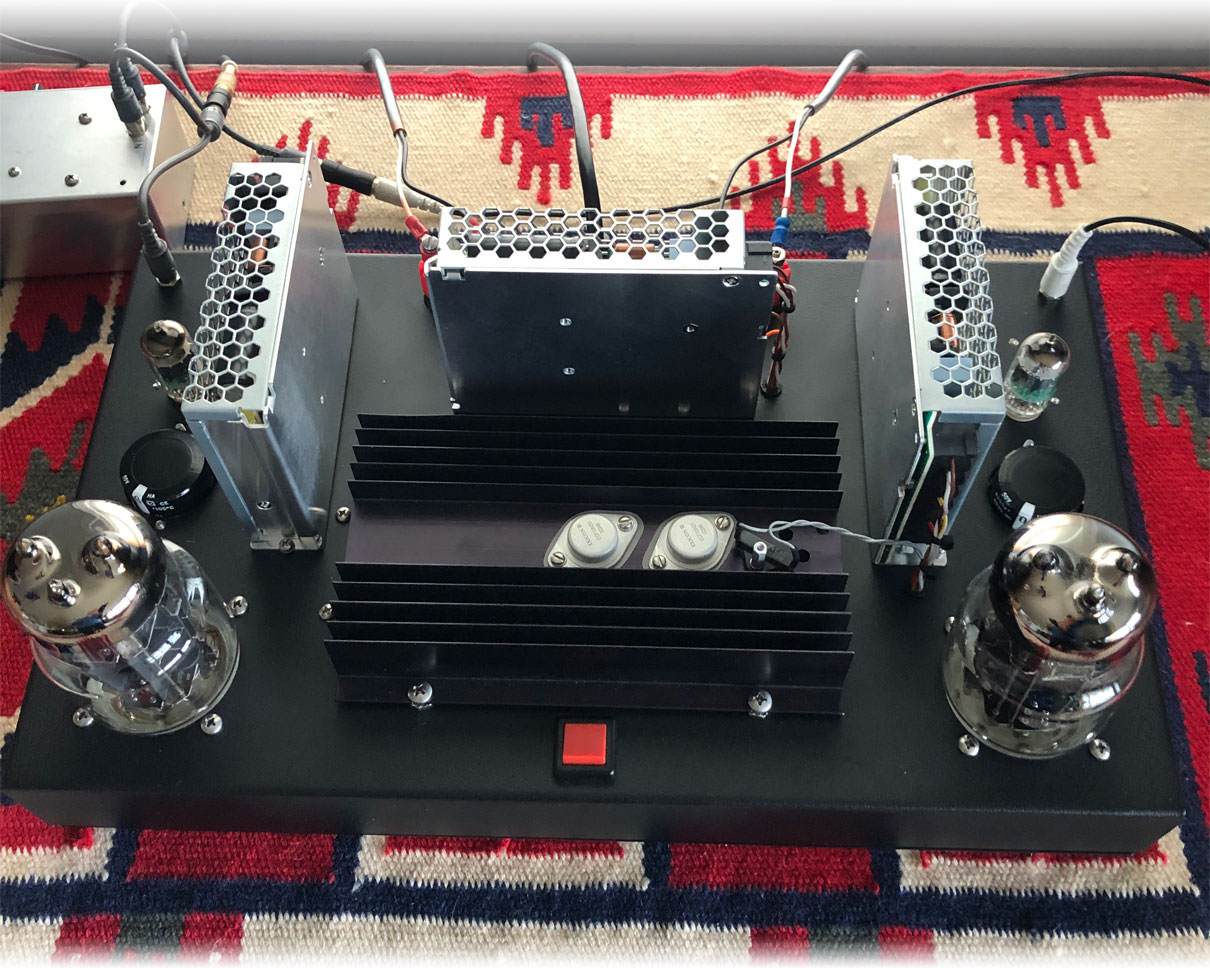
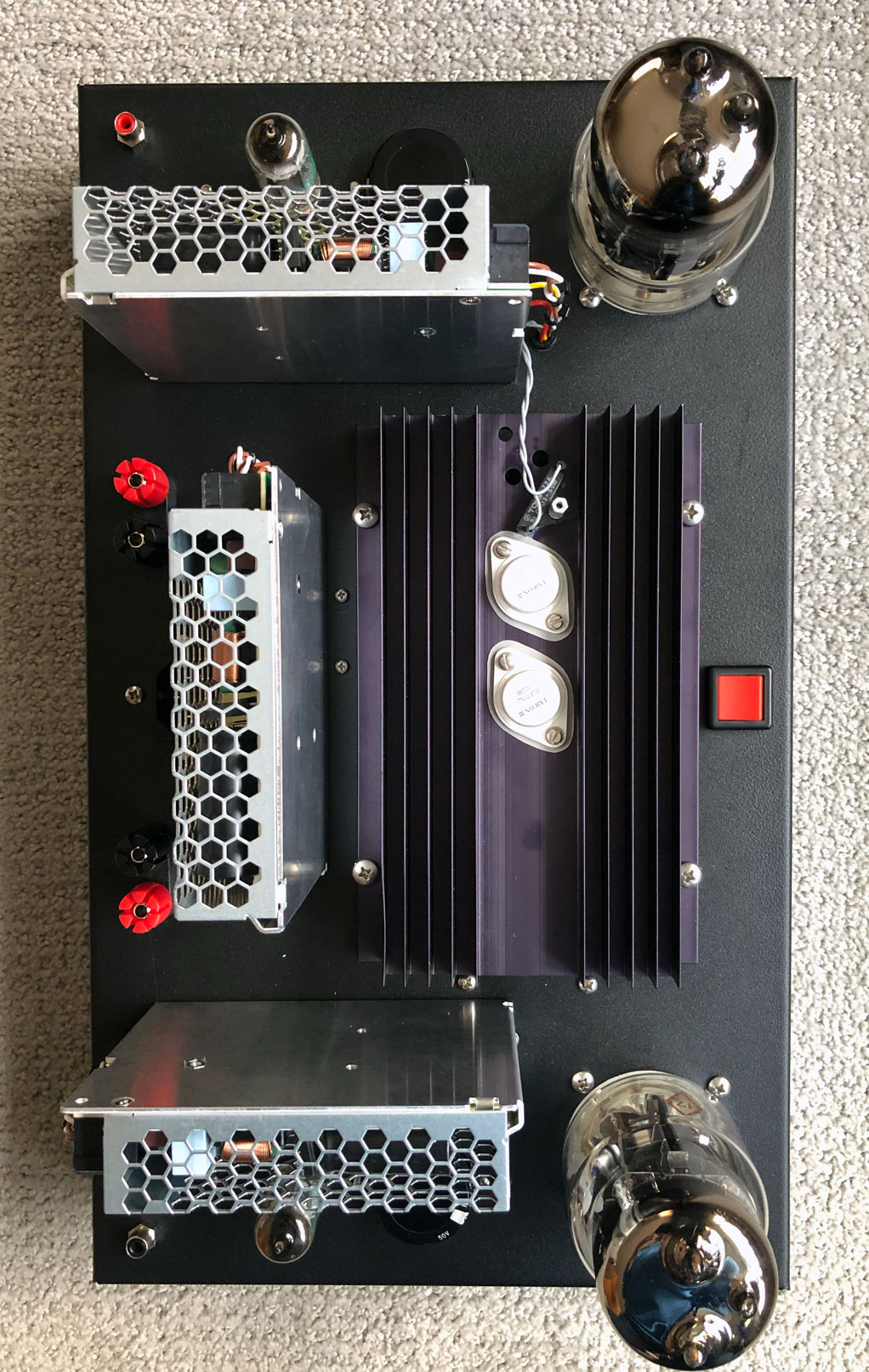
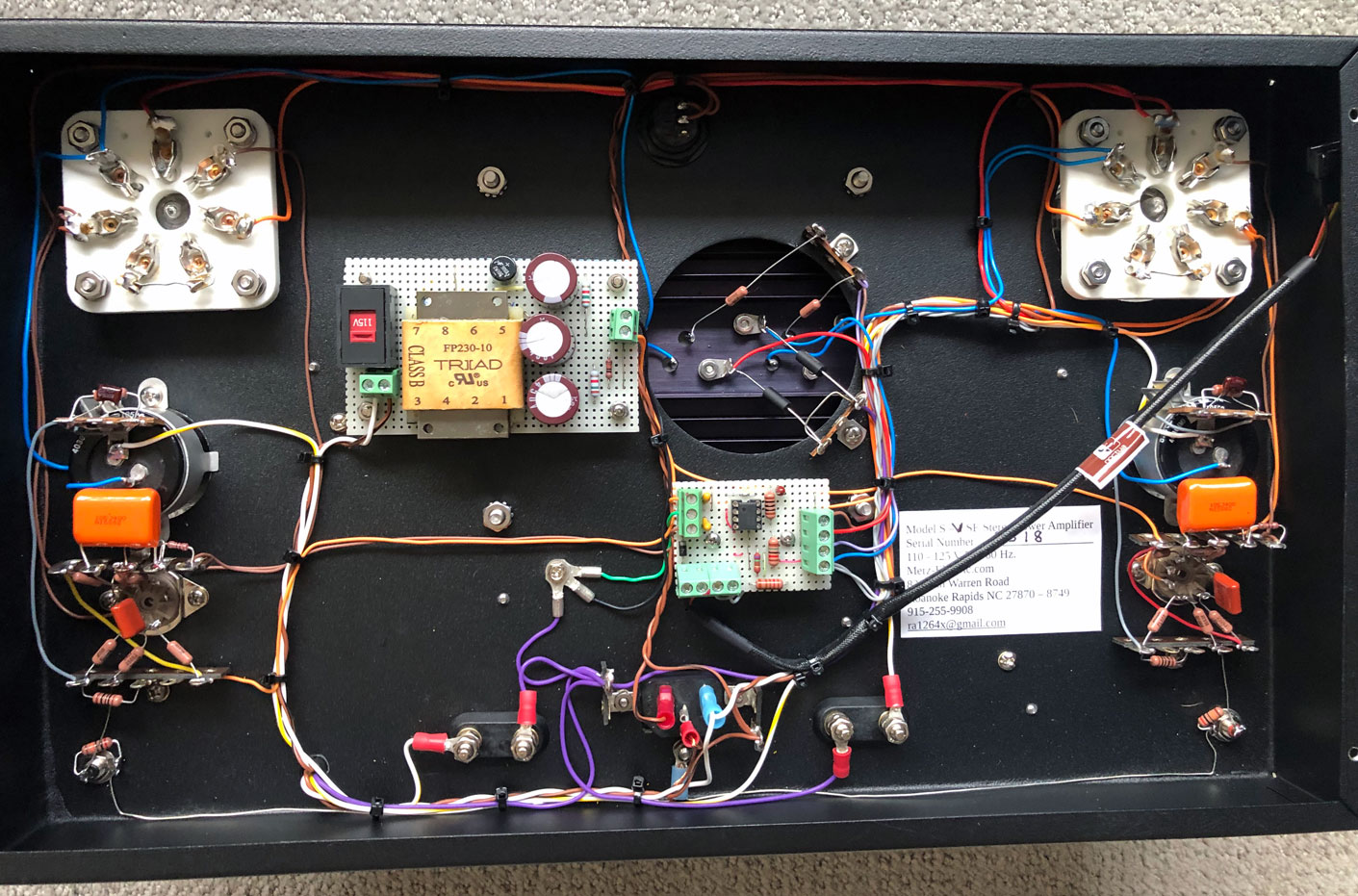
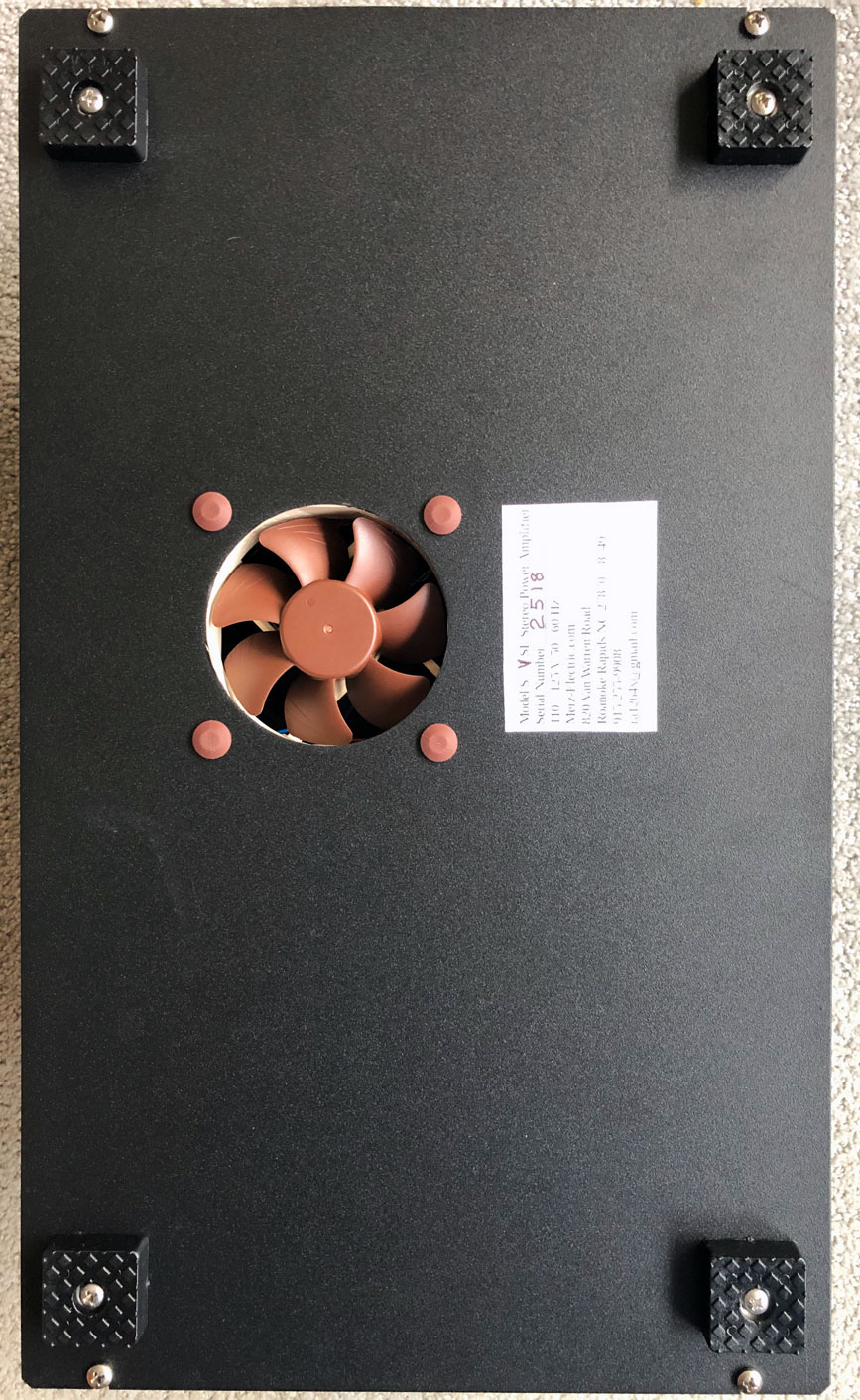
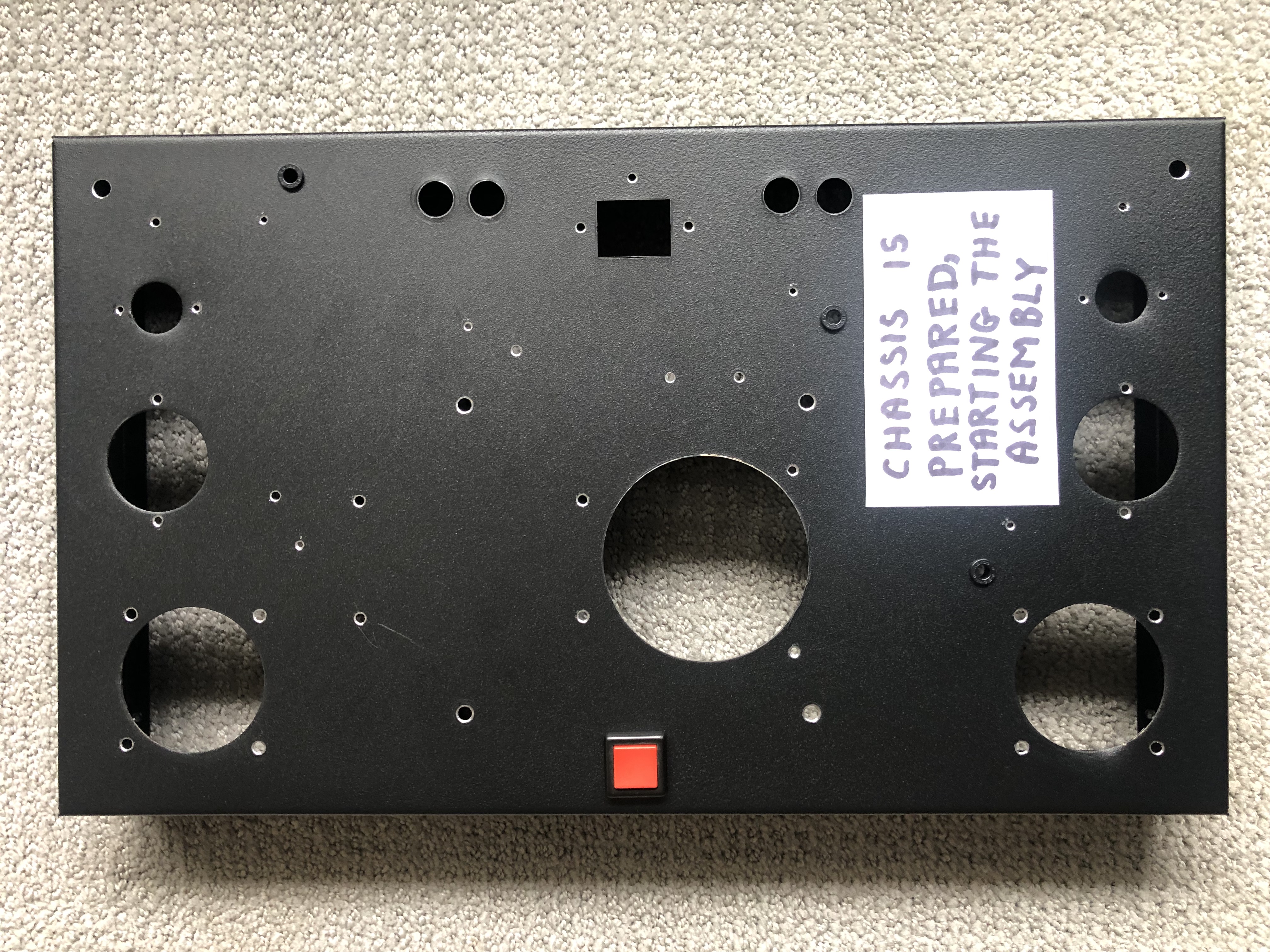
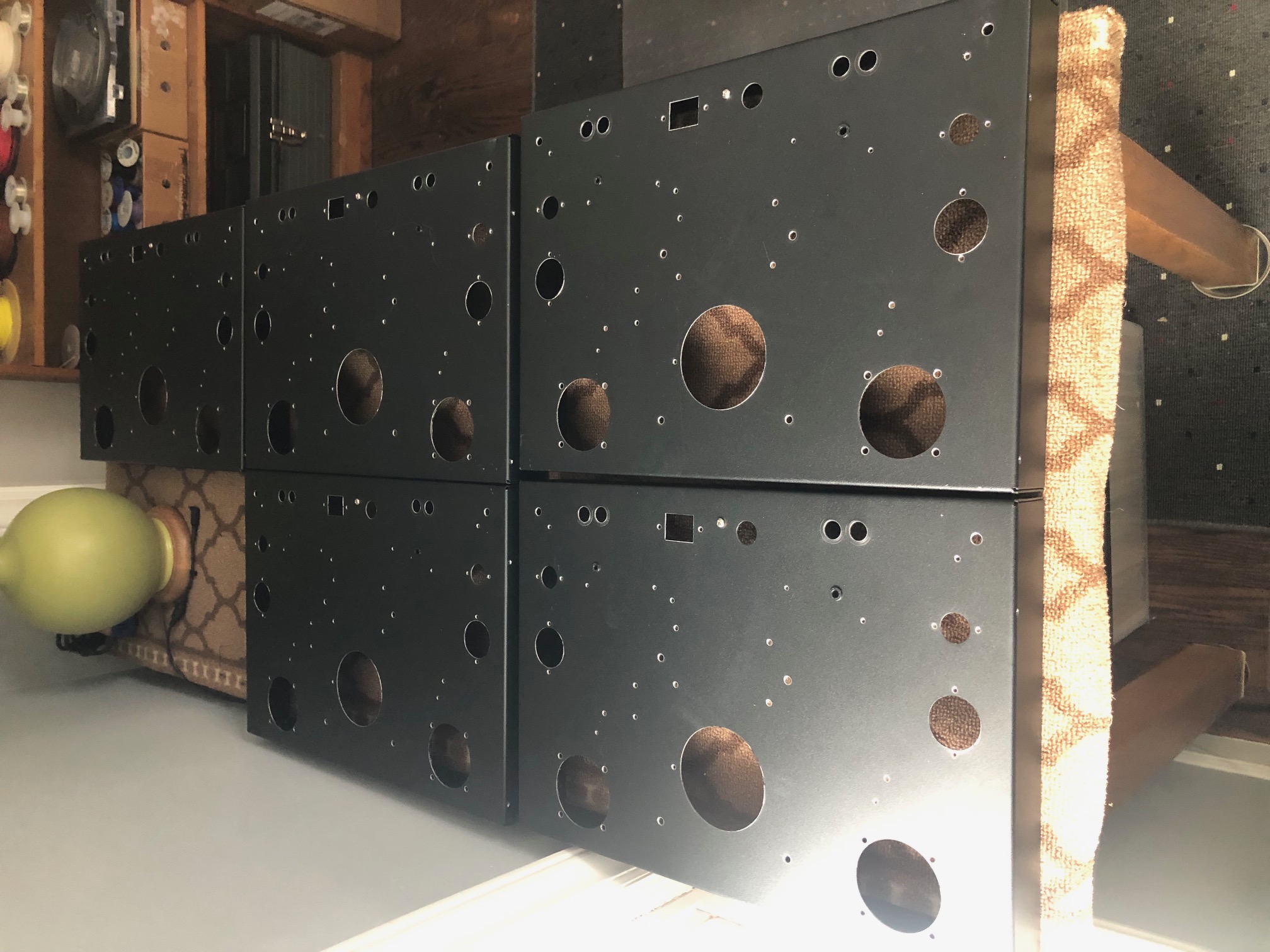
The SVS is currently for sale at $595 with $50 shipping and handling to all 50 U.S. states.
Model SVS Description
The Model SVS is a Stereo, Class A, Single-Ended, Low Power OTL (Output Transformer-Less) Vacuum Tube Power Amplifier designed for High Effieiency Loudspeakers.
Circuit Description (schematic sht. 1, one channel shown) The signal input is direct coupled to a conventional, two stage voltage amplifier V1 (tube type: 12AU7, 5814, 6189) The amplified signal is capacitively coupled to the grid of V2, a 6C33C-B high power, dual triode vacuum tube. The cathode of V2 is sourced from a 750 ma current regulator utilizing an N channel MOSFET Q1 (Exicon ECF10N20) The current regulator 750 mv reference is from voltage divider R14 and R15, this voltage is then matched with the current feedback voltage across R12. Operational amplifier, IC1 (type TL082) regulates the current via a signal to the gate of MOSFET Q1. The amplified signal at the cathode of V2 is developed across the Q1 current regulator and coupled through C4 to the speaker. A negative feedback signal from the speaker is fed back to the cathode of V1 via R9 and C3.
Power Supply for both channels (schematic sht. 2) The power supply for the +100 Volts on the plate of V2 is provided from two switching type, 48 VDC power supplies in series (SPS1 and SPS2) These two power supplies are adjusted for maximum output voltage of about 50 volts each. The heater power supply for both channels (SPS3) is a 24 volt switching type. The 12.6 volt heaters for both channels are connected in a series/parallel arrangement with the center point connected to chassis ground. This power supply is adjusted for 25.2 volts. It then provides the 12.6 volts for all four tubes as well as the +/- 12.6 volts required for IC1. Once correctly set for 25.2 volts, this regulated power power supply will provide the constant 750 mv reference voltage for IC1.
High B+ voltage for the two driver tubes is provided from a conventional power supply transformer (T1) The AC input to T1 is via a voltage selector switch S1 to allow for operation from either 110-120 V or 220-240 V 50 / 60 Hz. Switching power supplies, SPS 1,2 and 3 are self adjusting for different input voltages. The rectified and filtered B+ provides the approximately 250 vdc needed for V1.
Owner Reviews
" When I started my new audio journey about 6 years ago assembling my version of a dream system for me, it would have to follow a singular concept of simplicity. Short signal paths, higher efficiency speakers, minimalist circuits and so on. In other words: simple. Parts, get the heck out of the way and let me hear the music ! That's how I came to love the single-ended amplifier concept. Started with Pass Zen monoblocks and was astounded with the clarity and unfailing musicality that the exhibited. It was an "ear opener" so to speak. Intrigued by my experience with the Zen's, I decided to give single-ended tubes a chance and purchased a hyper built Clementine tube amplifier. It even had more of an enveloping musicality and you really could experience the "lit from within" quality so many single-ended oficianados rave about. I got it. Didn't think that it could get much better , but ( you know the story) it can.
Well , a friend of mine told me about an amplifier by a brilliant designer named Craig Merz that I should give a look at. The amplifier he was referring to is the Merz SVS single-ended, triode, OTL tube amplifier. At first, I was a little bit suspect. How can you make a single-ended OTL amplifier that can drive anything ? He told me Craig had it figured out. I thought "Hmm , single-ended, triode, OTL and hard wired to boot !" How can you get much better than that ? ! Intrigued, I had to get ahold of one. Problem solved. I called Craig and got my very own SVS on the way.
Boy, I sure am glad that I did. Got it hooked up to my 93db efficiency Spatial Audio M5 Sapphire open baffles and the rest is history as they say. Wow ! It had everything I was looking for and them some. It had transient speed, openess , big soundstage, tight and defined bass, no hashy, whitewashed treble, clarity in the midrange and above all: musicality! Musicality is a term that is somewhat ill defined and nebulous by absolute definition, but, if and when you hear it, it is very self evident. The Merz SVS brought this sense of musicality and cohesiveness to my system that wasn't there before. I can now follow each musicians lines throughout the song if I chose to do so or just sit back and enjoy the whole musical experience. In my opinion, it's that good. A real game changer for me.
If you have the right kind of speakers for this kind of amplifier, you can really go places sonically that you didn't know was there. Craig has really created a masterpiece in the SVS in my opinion and I hope to be able to check out some of his other sonic gems in the future. For now however, I'm just going to sit back and enjoy the sonic delights of the Merz SVS."
- Kyle Blackburn, Oklahoma City
"To start with I have owned two stereo amps that Craig made and one set of monoblocs. I enjoyed them all. The first was a design called Model OTL-20, it was 100 WPC OTL using 20 6080's, this one could fill a room with music and heat it at the same time, two of the stereo OTL’s used a pair of 6336's per channel 23 WPC, owning the first one was the reason I sold my Mark Levinson 332, it simply bettered the Levinson in every department but total power. The pair of monobloc's used a pair of 6C33's, I really didn't get to spend much time with these amps since a friend stopped by to hear them a few days after I got them and would not leave til I sold them to him, he was my best friend at the time so I feel the decision was just.
That brings me to the SVS using only one 6C33 per channel single ended OTL, at 2 WPC these amplifiers do need to be paired with speakers of at least 90db + sensitivity, but I did use it with a pair of Quad 63's and was very pleasantly surprised that listening to classical and jazz that I was able to listen to the them to the same sound level db's that I would be listening to with my larger Futterman type amplifiers. The only downfall is that when I put on rock and roll the limitation of 2 WPC came into play, they just couldn't make the quads rock. I also tried a pair of Sherwood Ravina's from the late 50's a three way 16 ohm design. The SVS had no issues with driving these speakers to levels louder than I generally listen too, unless a few sips of Johnny Walker is introduced.
In conclusion I think if you have a high efficiency pair of speakers that this amplifier may be everything you’re looking for, dead quiet, extremely wide bandwidth and great transient speed.
Thanks Craig! "
- Bryan Cook, Texas
Specifications (Both channels driven)
Power Output 4 Ω Load: 1 Watt / 8 Ω Load: 2 Watts / 16 Ω Load: 4 Watts
Input Sensitivity (VRMS) 4 Ω Load: .3 / 8Ω Load: .6 / 16 Ω Load: 1.2
Output Impedance: 1.15 Ω
Damping Factor 4 Ω Load: 4 / 8 Ω Load: 7 / 16 Ω Load: 13
Power Requirement: 110 – 120 V / 220 – 240 V 50 / 60 Hz. (Selected by Internal Switch)
Power Consumption: 290 Watts
Dimensions: 17” L x 10” D x 6 ½” H Weight: 10 Lbs. cdm 12-14-2025
The Circuit and Associated Parts
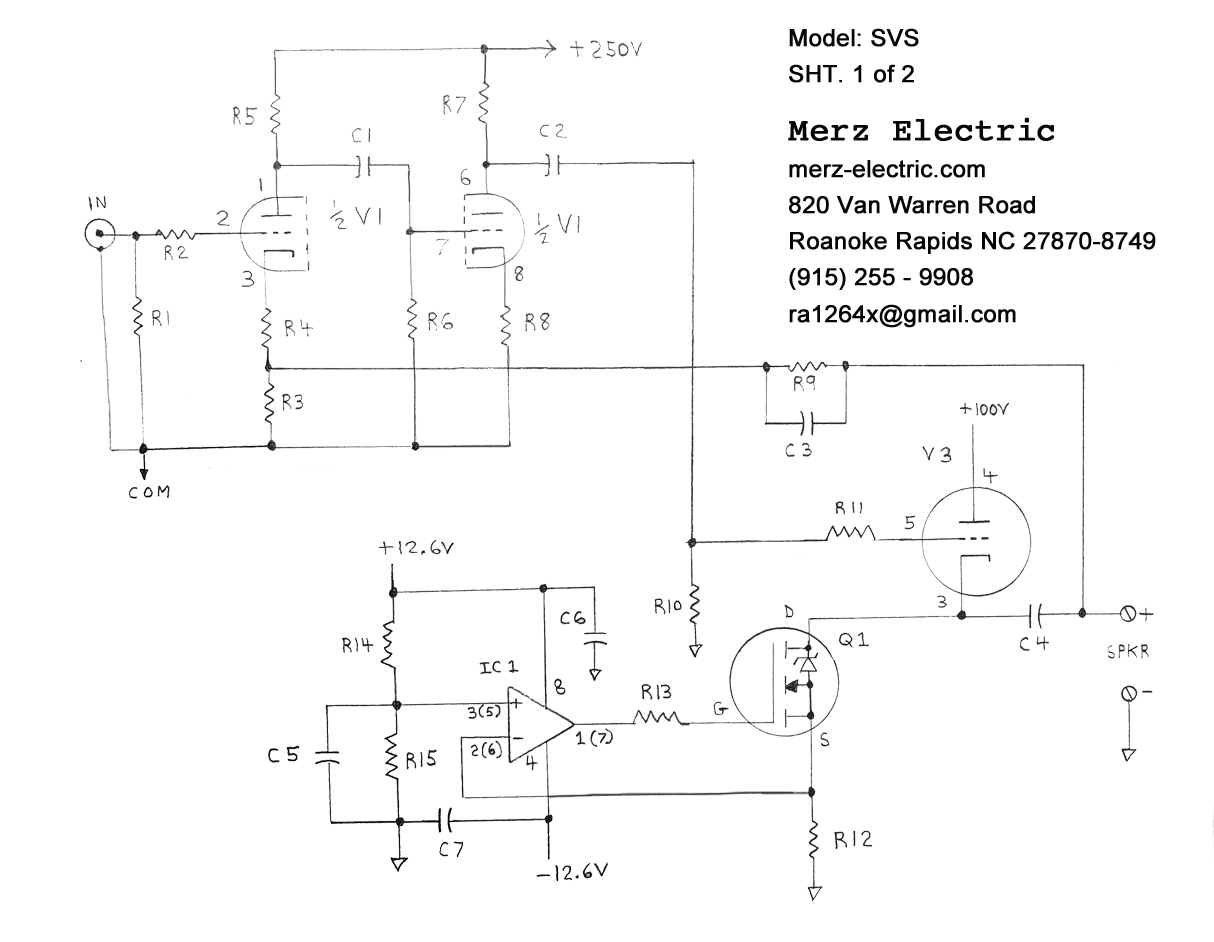
(Click to enlarge)
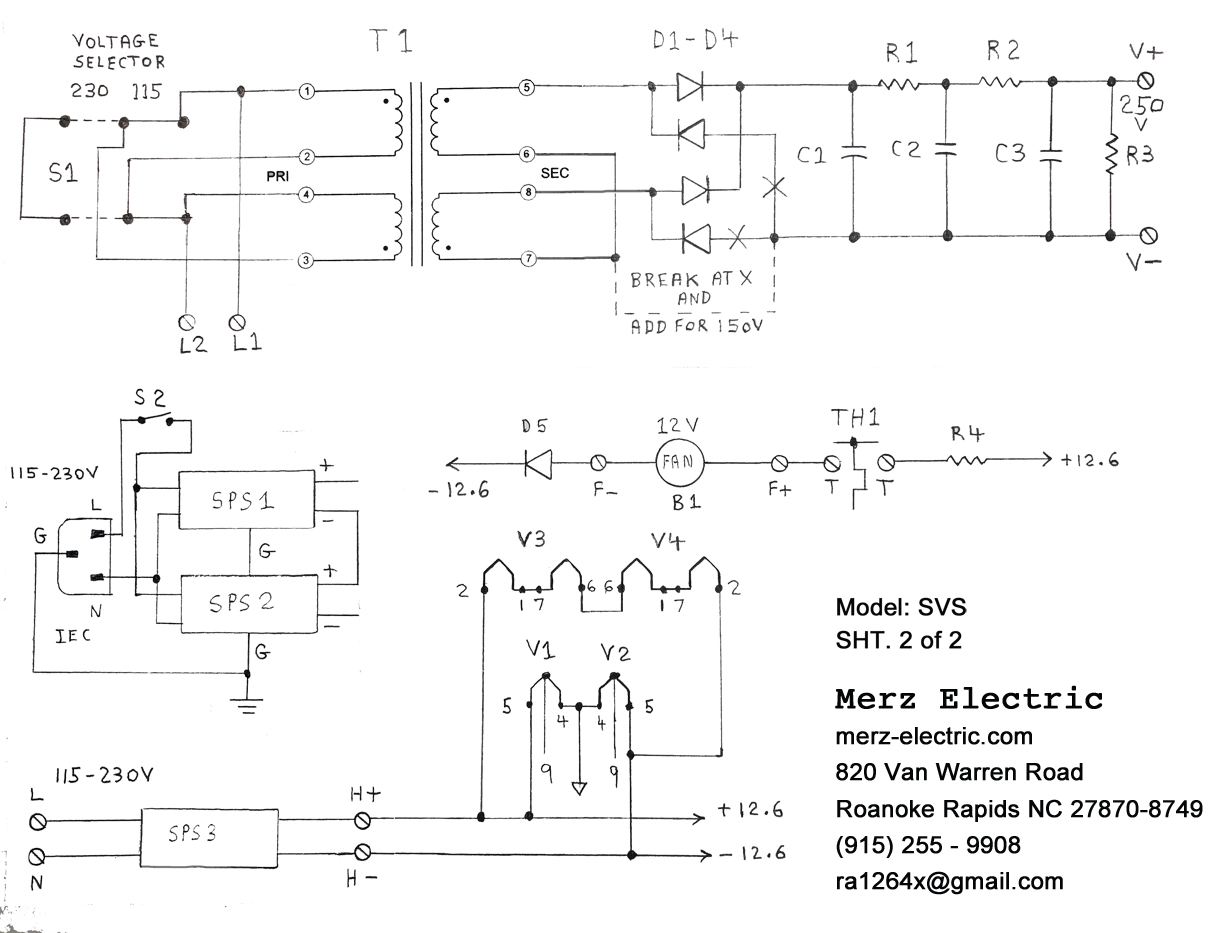
(Click to enlarge)
Model SVS Parts List, Driver and Output Stage (Schematic Sht. 1 of 2, one channel shown)
C1: .047 mfd 630V Film
C2: 10 mfd 400V film
C3: 270 pf 300V mica
C4: 8500 mfd 63V electrolytic
C5: 10 mfd 35V tantalum
C6, C7: 1 mfd 35V tantalum
IC1: TL 082 dual operational amplifier (TI)
J1: Keystone 576 (black) 580 (red)
Q1: Exicon ECF10N20 (N channel MOSFET)
R1, R10: 200K
R2 : 10K
R3,15: 100 Ω
R4, R8, R11: 1K
R5, R7: 100K
R9: 680 Ω
R12: .1 Ω 2W
R13: 330 Ω
R14: 15K
Note: All resistors, low noise, 1% film type, ½ watt (unless noted otherwise)
V1: 6189, 5814, 12AU7 vacuum tube
V2 : 6C33C-B vacuum tube (Russian mfr)
Model SVS Power Supply / Cooling Fan (sheet 2 of 2, for both channels) Parts List
B1: Fan, 12VDC (Noctua NF-A8 or Be Quiet, Pure Wings 2)
C1,C2,C3: 47 mfd 450V electrolytic
D1 - D4: 1N4007 or 1A 1000V bridge rectifier
D5 : 1N4007
R1,R2 : 1.5K 5% mf
R3: 100k 1% mf
R4: 365 Ω 1% 1W mf
S1: 115 / 230 voltage selector switch
S2: Power switch 125V 10A / 250V 5A
SPS1, SPS2: 48 VDC Meanwell LRS-100-48
SPS3: 24 VDC Meanwell LRS-100N2-24
T1: Transformer, Triad FP230-10
TH1: 50 Deg. C N.O. thermal switch, Kemet OHD3-50M
cdm 12-12-2025
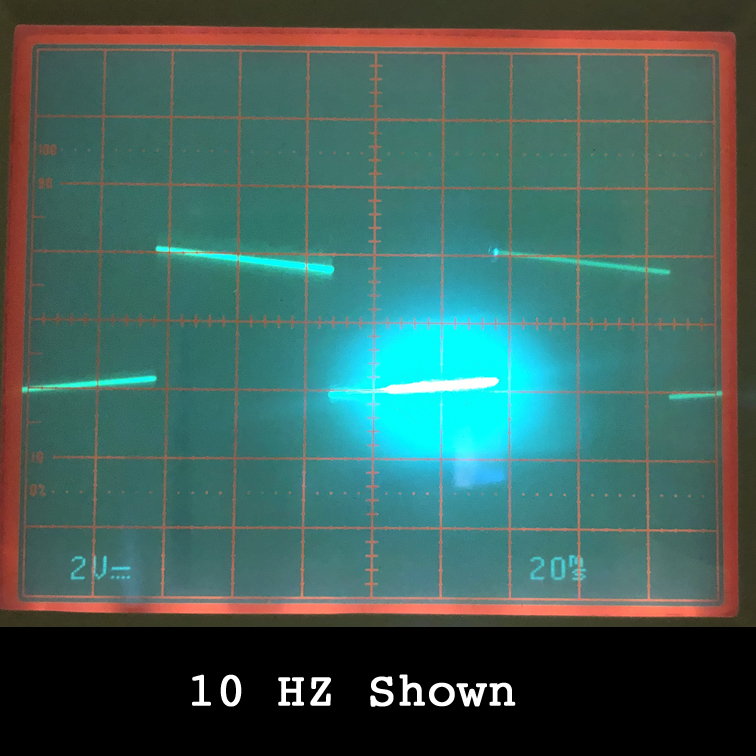
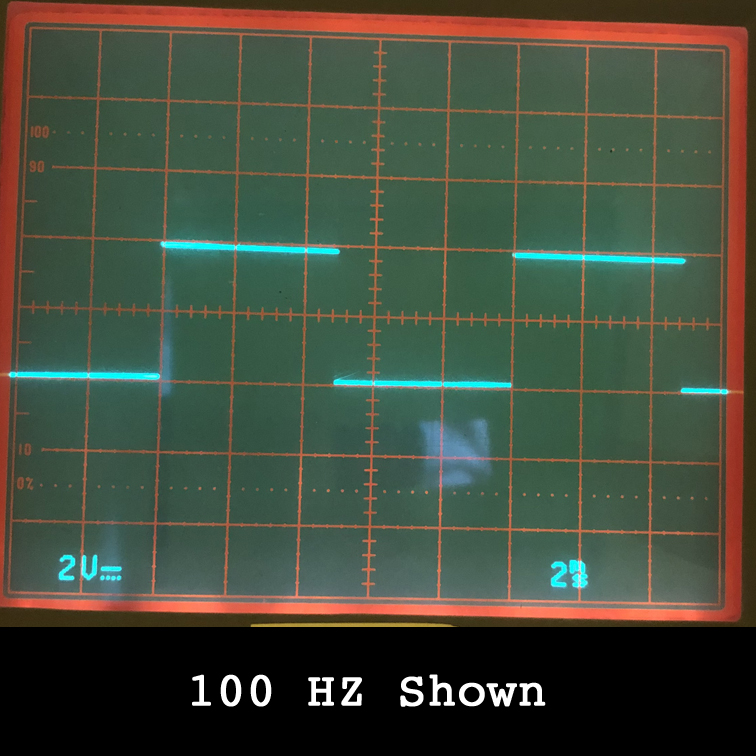
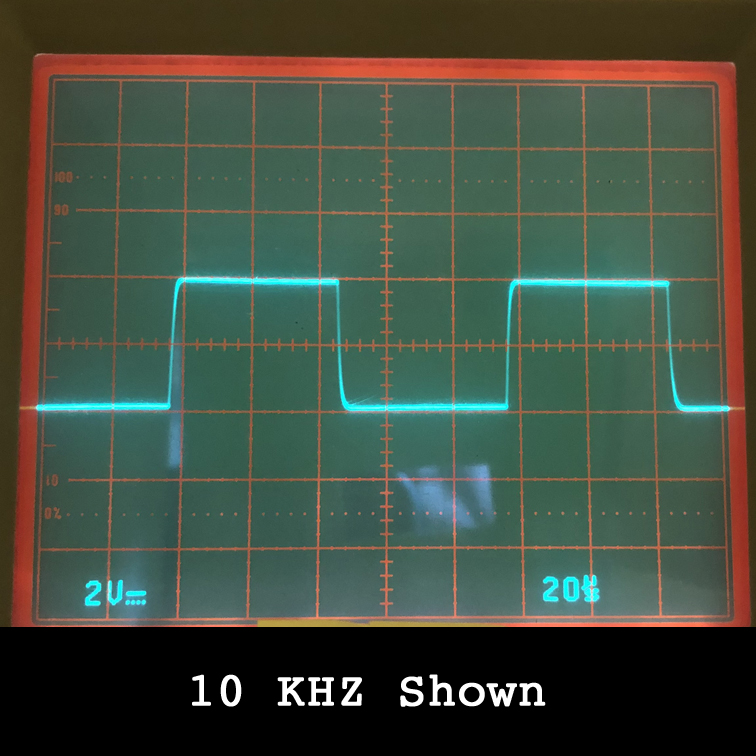
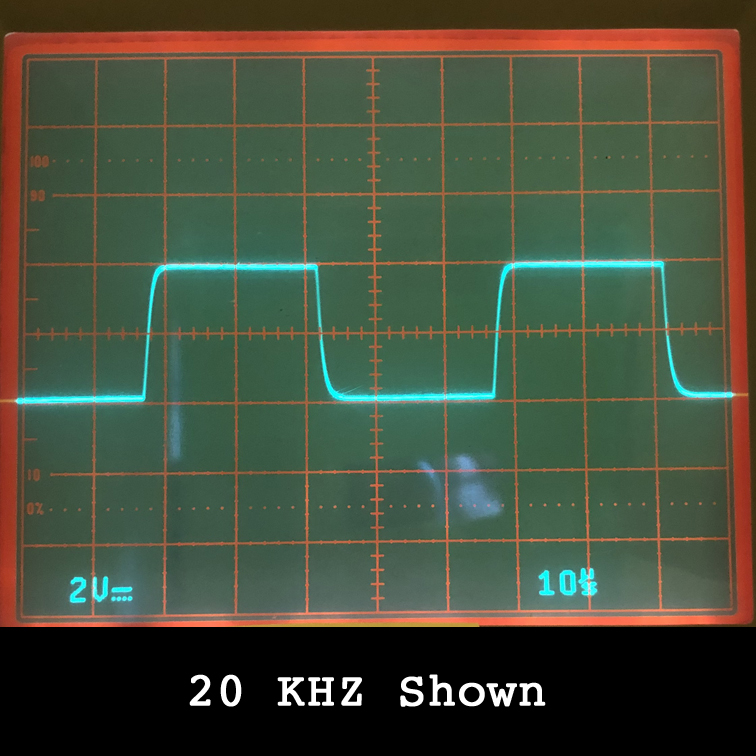
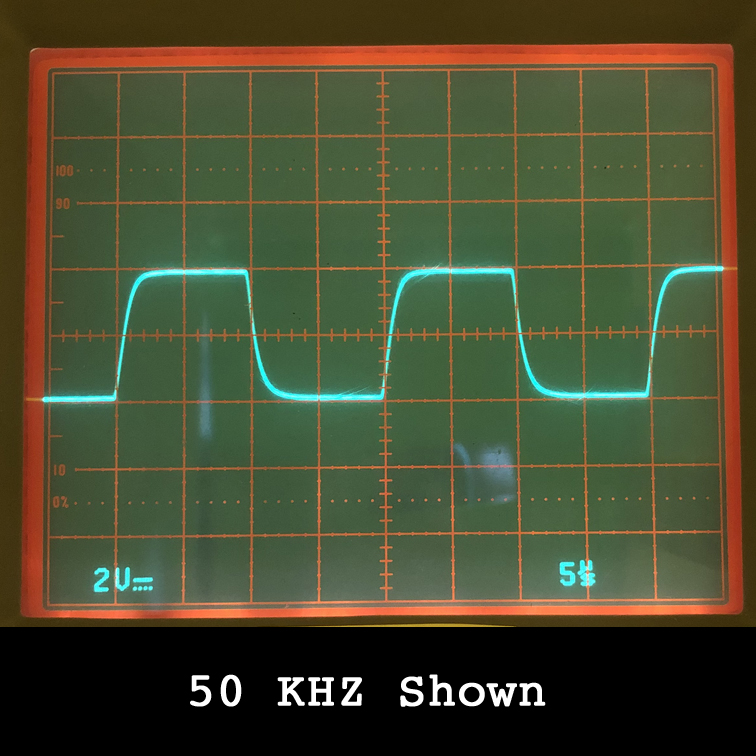
The Square Waves
Square wave photos don’t capture the full picture, but they provide a useful indication of how flat the amplifier’s response is. While square wave performance doesn’t directly reflect how the amplifier will sound, it does suggest a wide frequency response and minimal "ringing."
For clarity, one channel is shown here, though both channels were driven during the test.
Contact & Sales
Copyright © All rights reserved | Merz Electric